How high is the Sun on a flat Earth?
Sun and Moon · Updated
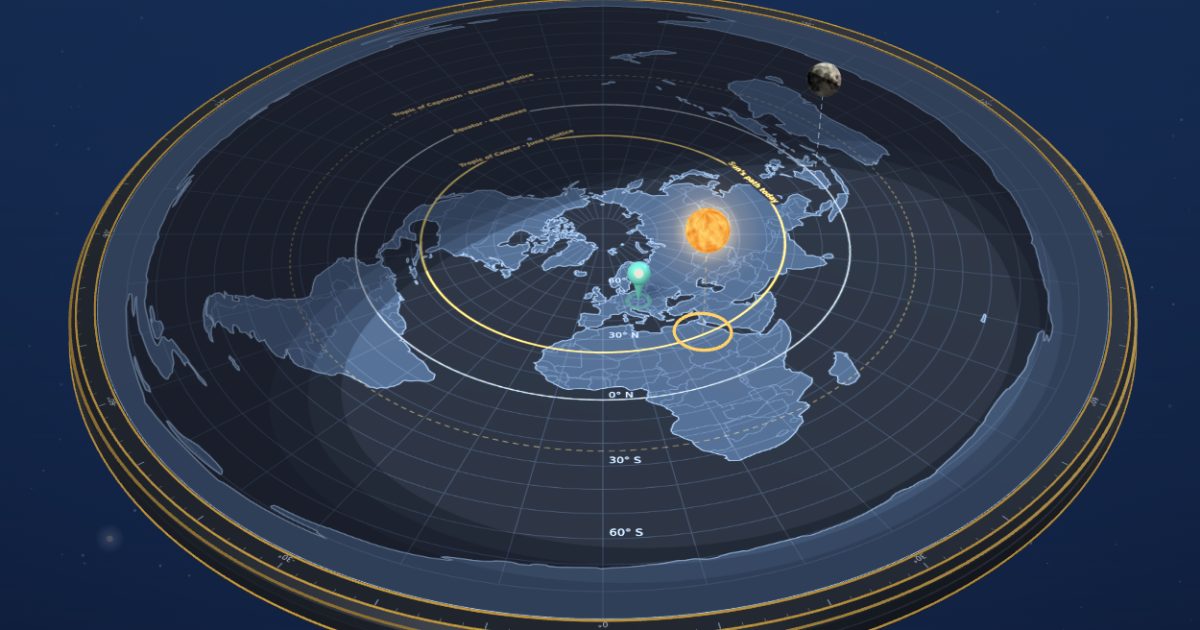
According to the Flat Earth Society, the Sun is about 3,000 miles (4,800 km) above the flat Earth and about 32 miles (51 km) across. Samuel Rowbotham, in Zetetic Astronomy (1881), put it 700 miles (1,100 km) above the point where it is overhead. Both figures come from measuring the Sun’s angle from two places and assuming the ground is flat.
Flat Earth Society: about 3,000 miles (4,800 km)
The Flat Earth Wiki estimates the Sun at about 3,000 miles above the surface when light travels in straight lines, and gives it a diameter of 32 miles. It notes that the same angles measured on a globe give a distance of nearly 93 million miles. In the wiki’s “Electromagnetic Acceleration” version, where light curves upwards, the Sun and other celestial bodies are about 6,000 miles up.
Samuel Rowbotham: 700 miles (1,100 km)
Rowbotham measured the Sun’s altitude from London and from the coast at Brighton, 50 miles apart, and drew the triangle on a flat base line. He concluded that “the distance of the sun over that part of the earth to which it is vertical is only 700 statute miles”, and that all the visible luminaries are within 1,000 miles. The 1865 edition of the same book gave other figures: the Sun under 4,000 miles and the stars within 6,000.
Flat Earth Sun heights compared
| Source | Sun height | Sun size | Moon |
|---|---|---|---|
| Flat Earth Society (straight-line light) | about 3,000 mi (4,800 km) | 32 mi (51 km) | same height and size as the Sun |
| Flat Earth Society (light bending upwards) | about 6,000 mi (9,650 km) | — | about 6,000 mi |
| Rowbotham, 3rd edition 1881 | 700 mi (1,100 km) | — | “nearer than the Sun” |
| Rowbotham, 1865 edition | under 4,000 mi | — | — |
How the height is measured
Both models use triangulation: the Sun’s angle above the horizon is measured at the same moment from two places a known distance apart. On a flat base line, the two angles meet at a height of a few thousand miles. FlatAtlas uses the same flat geometry in reverse: from a model height and your distance across the 40,000 km map, it calculates the angle at which you would see the Sun, and shows it next to the angle astronomy gives for the same moment.
How high would the Sun look from your city?
With the Sun 4,800 km up, the angle depends only on how far you are from the point below it. Overhead it is 90°. At 4,800 km away it is 45°. At 10,000 km it is about 26°, and at 20,000 km about 13°. FlatAtlas does this calculation for your place and the current time in “Check it in the sky”.
Frequently asked questions
How big is the Sun on a flat Earth?
The Flat Earth Society gives the Sun and the Moon a diameter of about 32 miles (51 km). Seen overhead from 4,800 km, a Sun that size would look about 0.6° wide.
Is the Moon closer than the Sun on a flat Earth?
In the Flat Earth Society model the Moon is at the same height as the Sun, about 3,000 miles. Rowbotham wrote that the Moon is nearer than the Sun but gave no figure.
Why do the flat Earth and globe give such different Sun distances?
Both start from the same measured angles. On flat ground the lines meet a few thousand miles up; on a curved Earth the same angles imply a Sun about 93 million miles away, as the Flat Earth Wiki itself notes.