Earth curvature calculator: how much does the horizon hide?
Free tool · Updated
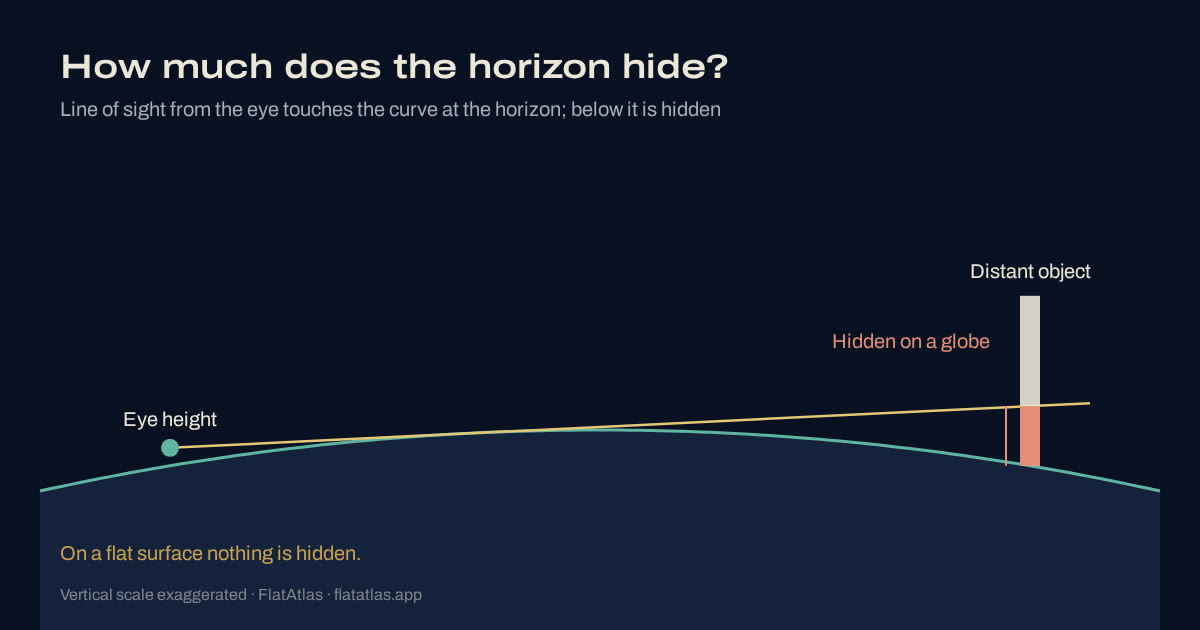
Enter how high your eyes are and how far away something is. The calculator shows how much of it a round Earth would hide below the horizon, with and without the usual bending of light near the ground. On a flat surface nothing is hidden. Then look with binoculars or a zoom lens and compare.
Astronomy and geodesy describe the Earth as a slightly flattened sphere about 12,742 km across, with the Sun about 150 million km away (NASA: Earth facts). FlatAtlas shows the published flat-Earth models next to that, so you can compare both with what you see.
How the calculator works
On a sphere with radius R, the horizon is √(2Rh) away for an eye height h. Anything farther is hidden from below by (d − d₀)² ÷ 2R, where d is the distance and d₀ the horizon distance. FlatAtlas uses R = 6,371 km. Light near the ground usually bends slightly downwards, which surveyors model with a refraction coefficient of about 0.13; it lets you see a little farther, as if the Earth were about 15% larger. Weather can make refraction much stronger or weaker, so real views vary.
The Bedford Level experiment
In 1838 Samuel Rowbotham sat in the Old Bedford River with his eye 8 inches above the water and watched a boat with a flag 3 feet high sail 6 miles away. He reported that the boat stayed visible down to the waterline, and calculated that a globe would hide more than 16 feet of it. Press the button above to see the same numbers. Read more in the Bedford Level experiment guide.
How to test it yourself
- Pick a target across a lake or the sea whose height you know: a lighthouse, a wind turbine, a tall building on the far shore.
- Measure the distance on a map and estimate your eye height above the water.
- Look with binoculars or a camera zoom from low and from high positions, and compare how much of the base you see with the numbers above.
- Repeat on a cool morning and a warm afternoon: refraction changes with the air.
Frequently asked questions
How much does the Earth's curvature hide at 10 km?
With your eye 2 m above the water, about 1.9 m of an object 10 km away is hidden by the curve without refraction, and about 1.4 m with standard refraction. On a flat surface nothing is hidden.
How far is the horizon?
Without refraction the horizon is about 3.6 km away for a 1 m eye height, 5 km for 2 m and 11.3 km for 10 m. Standard refraction makes it about 7% farther.
What was the Bedford Level experiment?
In 1838 Samuel Rowbotham watched a boat with a 3 ft flag sail 6 miles along the Old Bedford River with his eye 8 inches above the water, and reported it stayed visible down to the waterline. On a globe about 16 ft would be hidden at that distance without refraction.