Is there a dome over the flat Earth?
One Flat Earth Society writes that the Earth “is encased within a Dome, or Firmament”. The other, which runs the Flat Earth Wiki, has no dome at all and puts the stars in a layer above the Sun and the Moon. No society gives the dome a height, a material or an edge. Here is what each source says, word for word, next to what astronomy finds above us, and how FlatAtlas draws the dome.
Astronomy and geodesy describe the Earth as a slightly flattened sphere about 12,742 km across, with the Sun about 150 million km away (NASA: Earth facts). FlatAtlas shows the published flat-Earth models next to that, so you can compare both with what you see.
What is the dome, or firmament, in the flat Earth model?
It is a cover over the whole Earth, with the Sun, the Moon and the stars beneath it or set in it. The Flat Earth Society at theflatearthsociety.org answers the question in its FAQ: “The area where we live on the Flat Earth is encased within a Dome, or Firmament. In some texts its also referred to as The Vault of Heaven.” It adds that the idea “can be traced to Babylonian, Sumerian, Egyptian, and Christian world-views”.
The word firmament comes from the King James Bible. Genesis 1:6 reads: “Let there be a firmament in the midst of the waters, and let it divide the waters from the waters.” Verse 8 follows: “And God called the firmament Heaven.”
Do all flat Earth sources have a dome?
No. The two societies that share the name disagree, and so do the best-known authors.
| Source | Dome? | What it says |
|---|---|---|
| The Flat Earth Society (theflatearthsociety.org), FAQ | Yes | “encased within a Dome, or Firmament” |
| The Flat Earth Society wiki (wiki.tfes.org) | No | No page for a dome or firmament. The stars “move above the surface of the Earth in a layer above the Sun, Moon and planets”. |
| Wilbur Glenn Voliva, Zion (1931) | Yes | “The stars are set in a hemispherical dome so close to the earth that all cannot be seen at the same time” |
| Eric Dubay, The Flat Earth Conspiracy (2014) | Mentioned | Polaris is “situated atop the dome of the heavens” |
| Samuel Rowbotham, Zetetic Astronomy (1881) | Not described | He calls the sky the firmament and describes no dome; he limits the height of its lights. |
The wiki uses the word dome only for an optical effect: a straight line in the sky “will appear curved on a ‘celestial dome’”. On the Society’s own forum a member wrote: “it’s unzetetic to needlessly posit the existence of something we’ve never observed, and I have yet to observe a dome above the Earth holding the heavens in”.
How high is the flat Earth dome?
No Flat Earth Society publishes a height. The figures that exist come from individuals, or they are limits for the lights beneath the dome.
| Source | What it says | Height |
|---|---|---|
| The Flat Earth Society, FAQ | A dome, with no figure | Not given |
| The Society’s older FAQ (archived 2012) | “The stars are at a height of 3,100 miles above sea level” | Above 5,000 km, if the dome is above the stars |
| Mark Sargent, 2019 interview | “few hundred kilometers to several thousand kilometers”; “The lowest I think would be like 400 kilometers, 500 kilometers” | 400 km to several thousand km |
| Voliva, 1931 | A dome “so close to the earth that all cannot be seen at the same time” | Not given |
| Rowbotham, 1881 | “all the visible luminaries in the firmament are contained within a vertical distance of 1000 statute miles” | 1,600 km for the lights; no dome |
Sargent added: “we don’t know for sure”. He tied his lower limit to the nuclear tests at high altitude between 1958 and 1962. One of them, the American test Starfish Prime in July 1962, was detonated at 400 km.
What is the dome made of?
The societies do not say. The magazine Modern Mechanics wrote in October 1931 that Voliva’s world was “surmounted by a crystal dome in which the stars are hung like chandeliers to light the night”; the words are the reporter’s. The Flat Earth Society’s FAQ recalls peoples who saw the night sky as a tent, with the stars as “little holes poked in the hide of the tent”.
Where does the dome meet the Earth?
No source says. In the usual flat Earth map the rim is the ice wall of Antarctica, and the Flat Earth Society wiki writes: “Beyond the 150 foot Ice Wall is anyone’s guess.” A dome that rests on the ice wall is a drawing, not a published claim.
Are the stars on the dome or under it?
Both versions exist. Voliva’s stars “are set in” the dome. The Flat Earth Society wiki has no dome, and its stars move in a layer of their own, turning around a point above the North Pole once per sidereal day. See how the stars work on a flat Earth.
What does astronomy find above us?
No shell. The air gets thinner with height and has no sharp upper edge; by convention space begins at 100 km, the Kármán line. Above it:
- The International Space Station orbits about 400 km up and can be seen with the naked eye.
- Television and weather satellites in geostationary orbit stay 35,786 km above the equator.
- The Moon is 384,400 km away on average.
In this account the sky looks like a dome because we see no depth in it: every star seems equally far away.
How does FlatAtlas draw the dome?
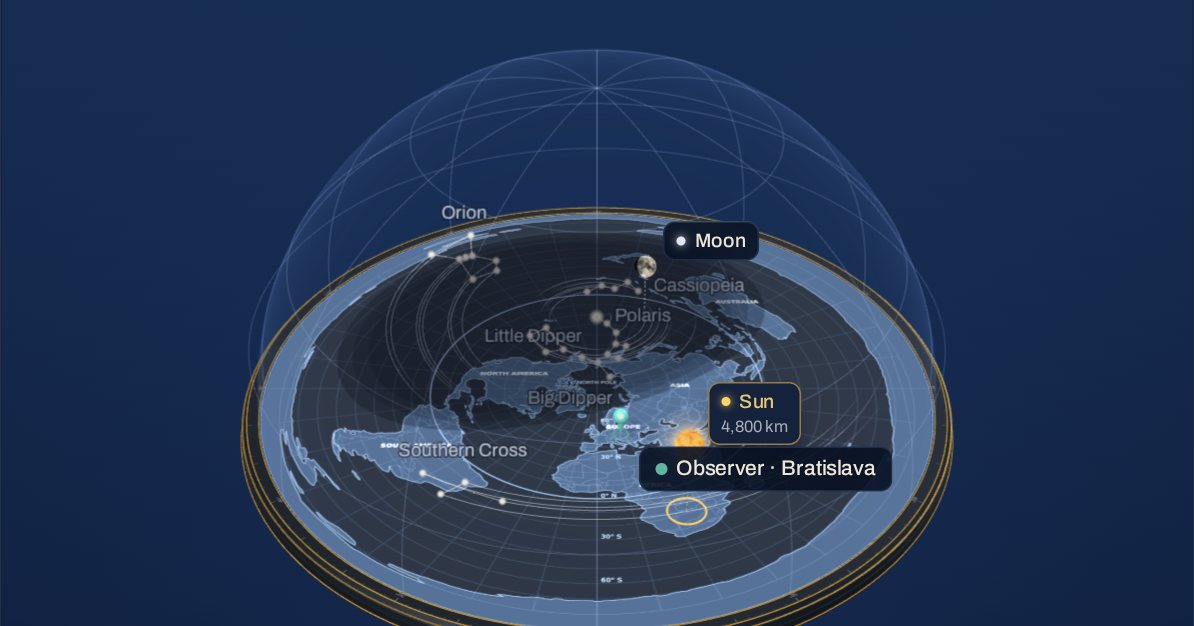
As an optional layer, Firmament (dome), which is off by default. It is a still half-sphere that rests on the rim of the map, drawn as a fine grid, so its top is 20,000 km above the North Pole. The stars turn beneath it in their flat layer, at the height your chosen model gives. The size and the shape of the dome are FlatAtlas’s drawing: no source publishes them. Open the 3D flat Earth map and turn the layer on in the list of layers.
How can you check for yourself?
- Watch the International Space Station. NASA’s Spot the Station lists the passes for your town. Note the time and the direction beforehand, then look. The station crosses the sky in a few minutes.
- Check a satellite dish. A dish aimed at a satellite on your own meridian is set to an elevation that follows from 35,786 km above the equator: about 31° at latitude 51.5° north and about 44° at 40° north. Read the elevation on the scale of the dish mount and compare.
- Photograph star trails. Leave a camera open for an hour, pointed north. The stars draw arcs around Polaris, as in the Star trails layer of FlatAtlas. Both accounts predict these arcs; they differ in what happens in the southern sky, which the guide to the stars covers.
Frequently asked questions
Is there a dome over the flat Earth?
It depends on the source. The Flat Earth Society at theflatearthsociety.org writes that the Earth “is encased within a Dome, or Firmament”. The Flat Earth Society wiki at wiki.tfes.org has no page for a dome and describes the stars as a layer. Astronomy finds no solid boundary: the air thins out gradually into space.
How high is the flat Earth dome?
No Flat Earth Society publishes a height. Mark Sargent said in 2019 that it could be “few hundred kilometers to several thousand kilometers” and that “we don’t know for sure”. The Society’s older FAQ put the stars at 3,100 miles, so a dome above them would be higher than that.
What is the firmament made of?
The societies do not say. A 1931 report on Wilbur Glenn Voliva’s flat Earth called it “a crystal dome in which the stars are hung like chandeliers”. The word firmament comes from Genesis 1:6 in the King James Bible.
Where does the dome meet the Earth?
No source says. The Flat Earth Society wiki writes: “Beyond the 150 foot Ice Wall is anyone’s guess.” FlatAtlas rests its dome on the rim of the map; that is its own drawing.
Sources
- The Flat Earth Society (theflatearthsociety.org): FAQ, archived 10 December 2023
- The Flat Earth Society (theflatearthsociety.org): FAQ, archived 30 October 2012
- The Flat Earth Wiki: Stars
- The Flat Earth Wiki: Celestial Sphere
- The Flat Earth Wiki: The Ice Wall
- The Flat Earth Society forum (forum.tfes.org): topic 8282
- Modern Mechanics and Inventions, October 1931: report on Wilbur Glenn Voliva’s flat Earth
- The Ebb Tide, April 2019: interview with Mark Sargent
- Eric Dubay, The Flat Earth Conspiracy (2014)
- S. B. Rowbotham, Zetetic Astronomy (1881), ch. V: The True Distance of the Sun
- King James Bible: Genesis 1:6–8
- Wikipedia: Atmosphere of Earth
- Wikipedia: Kármán line
- Wikipedia: International Space Station
- Wikipedia: Operation Fishbowl (Starfish Prime)
- Wikipedia: Geostationary orbit
- NASA: Moon facts
- NASA: Spot the Station