Polaris from the southern hemisphere: flat Earth vs globe
Polaris, the pole star, stands about 60° above the northern horizon in Oslo, about 31° in Cairo and just above the horizon in Quito, on the equator. From Sydney it is not seen at all. Samuel Birley Rowbotham explained this lowering of the pole star by perspective in Earth Not a Globe, and the Flat Earth Society wiki quotes his passage. The evidence map shows what each model gives for the four cities, and the form below lets you try your own angle.
Astronomy and geodesy describe the Earth as a slightly flattened sphere about 12,742 km across, with the Sun about 150 million km away (NASA: Earth facts). FlatAtlas shows the published flat-Earth models next to that, so you can compare both with what you see.
| Case | Flat Earth model | Globe | Observed |
|---|---|---|---|
| In Oslo Polaris stands high above the northern horizon | No published figure | 60.5° | Check it yourself |
| In Cairo Polaris stands lower in the northern sky | No published figure | 30.7° | Check it yourself |
| In Quito, on the equator, Polaris sits on the northern horizon | No published figure | 0.8° | Check it yourself |
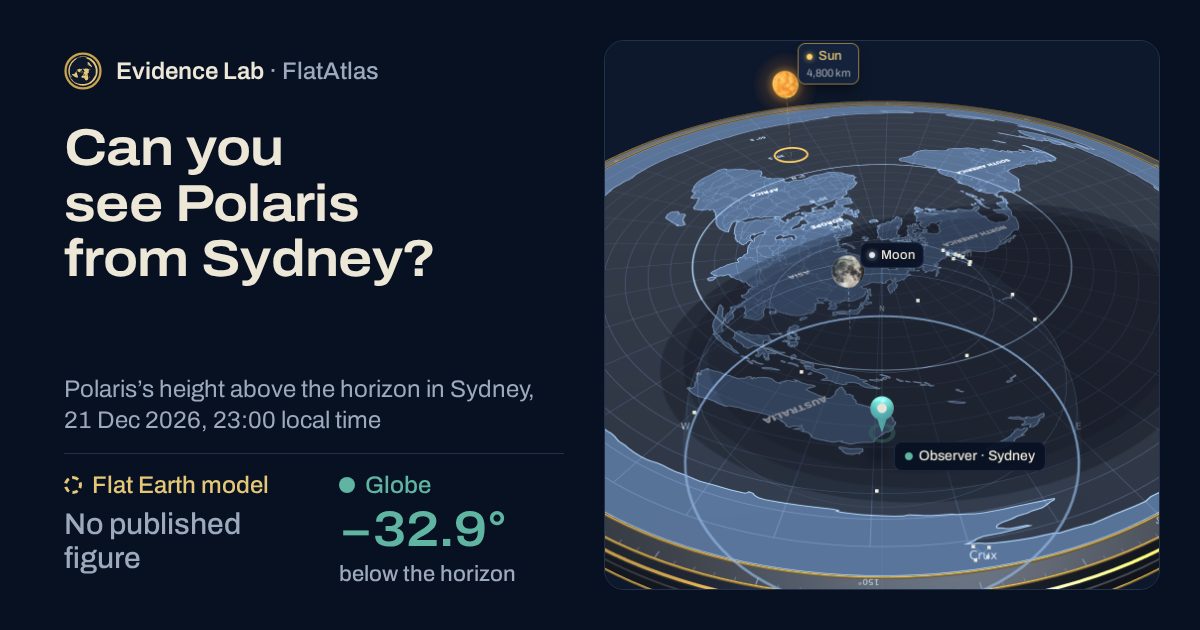
| In Sydney Polaris stays below the horizon | No published figure | -32.9° | Check it yourself |
Download the figures (CSV), free to reuse under CC BY 4.0 with a credit to the FlatAtlas Evidence Lab.
Evidence map
Cited by flat Earth supporters
This lowering of the pole star as we recede southwards; and the rising of the stars in the south as we approach them, is the necessary result of the everywhere visible law of perspective operating between the eye-line of the observer, the object observed, and the plane surface upon which he stands; and has no connection with or relation whatever to the supposed rotundity of the earth.
In Oslo Polaris stands high above the northern horizon
Flat Earth model
No published figure
The Flat Earth Society wiki places the stars “a few thousand miles” above the Earth and gives no height for Polaris. It explains the pole star's angle by perspective: an object looks lower the farther the observer is from it. On a straight sight line over the FlatAtlas map, a star above the North Pole would have to be about 5,910 km up to appear at the angle astronomy gives from Oslo, 3,343 km from the pole.
Globe
60.5°
On the globe Polaris lies almost on the line of the Earth's axis, so its angle above the horizon is close to the observer's latitude: Oslo is at 60° N.
Observed
No independent record yet
On a clear night, measure Polaris's angle above the northern horizon with a protractor and a plumb line, or with a phone inclinometer app, and compare it with both figures.
You can check it yourselfIn Cairo Polaris stands lower in the northern sky
Flat Earth model
No published figure
In Rowbotham's account the pole star sinks as the observer moves south, like a lamp-post seen from farther away. The wiki gives no height for it. On a straight sight line over the FlatAtlas map, the angle astronomy gives from Cairo, 6,662 km from the North Pole, would need a star about 3,960 km up.
Globe
30.7°
Cairo is at 30° N, so on the globe Polaris stands about 30° above its northern horizon.
Observed
No independent record yet
Measure Polaris's angle from Cairo or any place near 30° N and enter it with your latitude in the form below.
You can check it yourselfIn Quito, on the equator, Polaris sits on the northern horizon
Flat Earth model
No published figure
Rowbotham describes the pole star approaching the vanishing point, where the line of sight and the surface seem to meet, as the observer nears the equator. On a straight sight line over the FlatAtlas map, the angle astronomy gives from Quito, 10,020 km from the North Pole, would need a star about 140 km up.
Globe
0.8°
Quito lies almost on the equator, so on the globe Polaris is on the northern horizon, lifted slightly by atmospheric refraction.
Observed
No independent record yet
From a place near the equator with a clear, low northern horizon, look for Polaris just above it.
You can check it yourselfIn Sydney Polaris stays below the horizon
Flat Earth model
No published figure
Rowbotham writes that the pole star becomes invisible once the observer passes the equator, beyond the vanishing point of perspective. The wiki gives no distance for that vanishing point, and on a straight sight line no height above the map places a star below the horizon.
Globe
-32.9°
Sydney is at 34° S; on the globe Polaris is then about 33° below the horizon, behind the curve of the Earth.
Observed
No independent record yet
Ask someone in Sydney, or look at photos of the northern night sky taken in Australia, for Polaris and the Little Dipper around it.
You can check it yourself
Evidence and data quality
- Single report Flat Earth model Earth Not a Globe, ch. 14: Declination of the Pole Star: Rowbotham's original chapter, “Declination of the Pole Star”, compares the pole star with a row of lamp-posts that look lower the farther away they are.
- Single report Flat Earth model The Flat Earth Wiki: Star Rotation: On the wiki the stars turn “with Polaris at the hub”, above the North Pole at the centre of the map.
- Single report Flat Earth model The Flat Earth Wiki: Stars: The stars move in a layer above the Sun, Moon and planets; the page gives no height.
- Single report Both Wikipedia: Polaris: Navigators read their latitude from Polaris's angle above the horizon.
- Calculation from a model Both FlatAtlas: The flat Earth map (Gleason 1892): The map FlatAtlas uses for each city's distance from the North Pole.
- Calculation from a model Globe Astronomy Engine (Sun and Moon positions): Star positions for any place and time on the globe; FlatAtlas uses it for the sky dome and every globe figure.
Data quality says how a figure was obtained, on the same scale for both sides. It does not rate which model is right.
Run the test
The same 3D model as the FlatAtlas app, with the Flat Earth Society heights for the Sun and Moon. The dome over the observer is the globe’s sky: star positions from astronomy (astronomy-engine), drawn over the FlatAtlas map. The Flat Earth model publishes no star positions, so the test does not draw any of its own. Each place is shown at its own moment: Oslo, 21 December 2026 at 21:00 UTC; Cairo, 21 December 2026 at 20:00 UTC; Quito, 22 December 2026 at 04:00 UTC; Sydney, 21 December 2026 at 12:00 UTC. Switch the observer between the places and find Polaris on the sky dome.
Free: the Sun and the Moon from your place, right now. Pro: this sky from your place, star by star, on the test’s date or any date from 1900 to 2100. One payment, no subscription.
Try your own Polaris angle
Flat Earth map, straight sight line: Polaris’s height above the North Pole
Globe: angle minus latitude
The height is a straight sight line over the FlatAtlas map, with the North Pole at the centre. It is not a figure the Flat Earth model publishes: the model explains the angle by perspective. Read this way, the same star would be about 5,910 km up seen from Oslo, 3,960 km from Cairo and 140 km from Quito. Oslo’s figures are filled in.
Why is Polaris cited in the flat Earth debate?
On the north-polar Flat Earth map the North Pole is the centre, and the Flat Earth Society wiki describes the stars turning around Polaris above it. Travelling south takes an observer away from the centre, and Polaris sinks towards the horizon until it is gone south of the equator. Rowbotham read this as perspective over a plane surface; on the globe it follows from the curve of the Earth between the observer and the line of the axis.
What does the 3D test show?
Switch the observer between Oslo, Cairo, Quito and Sydney, each on a December night. The dome over the observer is the globe's sky from astronomy; the Flat Earth model publishes no star positions, so the dome is not the model's prediction. The line under the scene gives Polaris's angle for the chosen place. The same question for the southern sky is on the Southern Cross from Europe and Australia and the south celestial pole.
Frequently asked questions
Can you see Polaris from the southern hemisphere?
Not from much south of the equator. Near the equator it sits on the northern horizon; from Sydney or Cape Town it stays below the horizon all night.
Can you see Polaris from Australia?
No. On the globe Polaris stays below the horizon all night from every part of Australia: at its highest it is about 9.5° below the horizon at the northern tip of Cape York, about 11° below in Darwin and about 33° below in Sydney (Astronomy Engine, December 2026). The Flat Earth model gives no figure for it.
How does the flat Earth model explain Polaris getting lower?
By perspective. Rowbotham compared the pole star with a row of lamp-posts that look lower the farther away they are, and wrote that past the vanishing point it becomes invisible. The Flat Earth Society wiki quotes this passage and gives no height for the star.
Can I check it myself?
Yes. Measure Polaris's angle above the horizon on a clear night, enter it with your latitude in the form on this page, and compare how each model reads it.
See this sky in My Sky in the app (Pro)