The total solar eclipse of 2 August 2027: flat Earth vs globe
On Monday 2 August 2027 the Moon passes in front of the Sun along a narrow path from the Strait of Gibraltar across North Africa to Egypt and Arabia. Southern Spain sees the total eclipse in the morning, around 08:47 UTC; most of Europe sees only part of the Sun covered, and southern Africa, from Angola and Zambia to the Cape, sees no eclipse at all. The Flat Earth Society wiki says a solar eclipse happens when the Moon blocks the path of light between the Sun and the observer. The evidence map compares the angle between the Sun and the Moon in each model from four places.
Astronomy and geodesy describe the Earth as a slightly flattened sphere about 12,742 km across, with the Sun about 150 million km away (NASA: Earth facts). FlatAtlas shows the published flat-Earth models next to that, so you can compare both with what you see.
| Case | Flat Earth model | Globe | Observed |
|---|---|---|---|
| From Tarifa, at the southern tip of Spain, the Moon covers the whole Sun | 9.7°† | 0° | Check it yourself |
| From Luxor, Egypt, near the middle of the path, the Moon covers the whole Sun high in the sky | 5.0°† | 0° | Check it yourself |
| From Bratislava the Moon covers less than half of the Sun | 11.1°† | 0.3° | Check it yourself |
| From Cape Town the Moon passes beside the Sun and there is no eclipse | 10.6°† | 1.0° | Check it yourself |
Worked out by FlatAtlas from the model as published, such as a flat surface, or the Sun and Moon heights FlatAtlas uses over Gleason’s map; the model itself gives no such figure. Each side’s own explanation is in the evidence map below.
Download the figures (CSV), free to reuse under CC BY 4.0 with a credit to the FlatAtlas Evidence Lab.
Evidence map
Cited by flat Earth supporters
A Solar Eclipse occurs when an observer on Earth passes through the shadow cast by the Moon which fully or partially blocks the Sun.
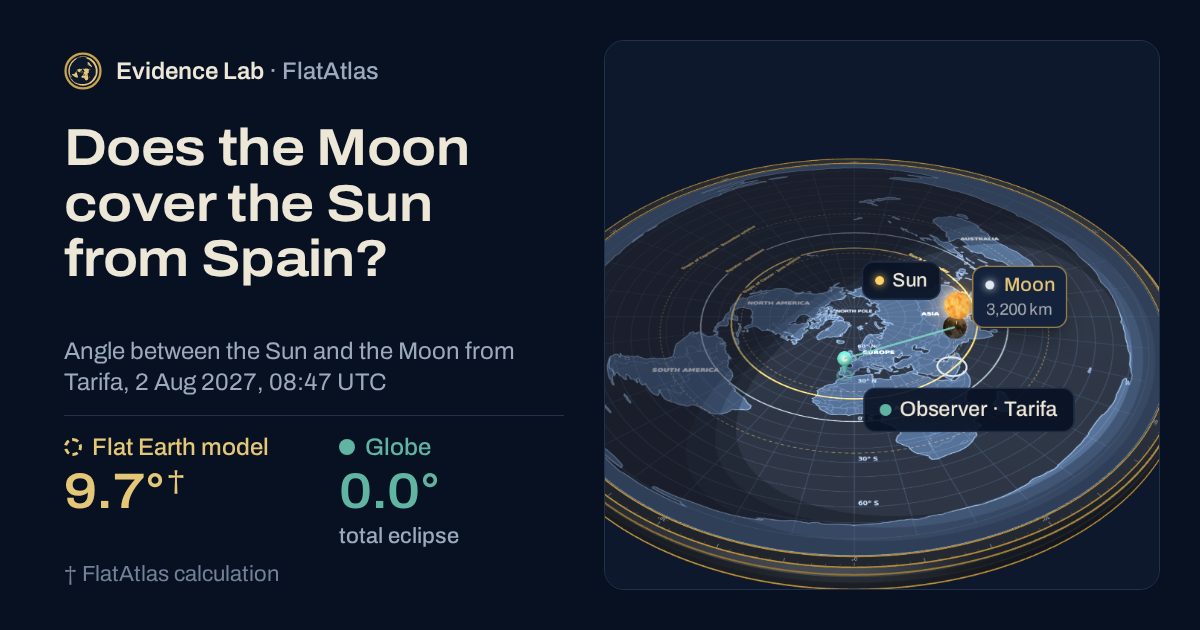
From Tarifa, at the southern tip of Spain, the Moon covers the whole Sun
Flat Earth model
9.7°
The wiki says the eclipse happens “when the Moon blocks the path of light between the Sun and the observer, and when the Moon is close to the ecliptic”. It gives no heights at which the two line up. On the FlatAtlas map the points under the Sun and the Moon are both about 6,700 km from Tarifa at the middle of the eclipse; with the Sun 4,800 km and the Moon 3,200 km above them, the two sight lines are about 10° apart, the Sun at 35° and the Moon at 26°; the Moon's height is FlatAtlas's reading of the wiki's “several thousand miles”.
Globe
0°
On the globe Tarifa lies inside the path of totality: at 08:47 UTC the Moon stands in front of the Sun, 38° above the eastern horizon, and the Moon's disc, 7% wider than the Sun's from there, hides it completely.
Observed
No independent record yet
On 2 August 2027, from Tarifa, Cádiz or Málaga, watch the Sun through certified eclipse glasses from about 07:40 UTC. Note the time the last sliver of Sun disappears and the time it comes back.
You can check it yourselfFrom Luxor, Egypt, near the middle of the path, the Moon covers the whole Sun high in the sky
Flat Earth model
5.0°
Luxor is about 60 km from the point of the greatest eclipse. On the FlatAtlas map the points under the Sun and the Moon are about 930 km and 920 km from Luxor at that moment, and the two sight lines are about 5° apart. The wiki gives no figure for the angle between the two from a given place.
Globe
0°
On the globe the Sun and the Moon are in line 82° above the horizon at 10:05 UTC. The greatest eclipse, with about 6 min 23 s of totality, is about 60 km south-east of Luxor.
Source: NASA Eclipse Web Site: Total Solar Eclipse of 2027 Aug 02, interactive path map
Observed
No independent record yet
Time-stamped photos and videos of the totality from Luxor on 2 August 2027 will show the Sun almost overhead and the length of the totality.
You can check it yourselfFrom Bratislava the Moon covers less than half of the Sun
Flat Earth model
11.1°
The wiki says the Moon “fully or partially blocks the Sun”, without saying where on the Flat Earth map the partial eclipse is seen. On the FlatAtlas map the two sight lines from Bratislava at 09:18 UTC are about 11° apart.
Globe
0.3°
On the globe Bratislava is about 1,500 km north of the path of totality. Seen from there the centres of the Sun and the Moon are 0.3° apart at 09:18 UTC, and the Moon covers 47% of the Sun's disc.
Observed
No independent record yet
With eclipse glasses or a pinhole projector, watch the Sun from Bratislava between 08:15 and 10:23 UTC and sketch the bite out of its disc at 09:18 UTC, or photograph it through a solar filter on the lens.
You can check it yourselfFrom Cape Town the Moon passes beside the Sun and there is no eclipse
Flat Earth model
10.6°
On the FlatAtlas map the two sight lines from Cape Town at the greatest eclipse are about 11° apart. The wiki's account of the eclipse, the Moon's shadow falling on the observer, does not say where on the map the shadow does not reach.
Globe
1.0°
On the globe Cape Town is far south of the Moon's shadow: at 10:07 UTC the centres of the Sun and the Moon are 1.0° apart, more than the 0.54° at which their discs would start to overlap, so the Sun stays whole.
Observed
No independent record yet
Anyone in Cape Town on 2 August 2027 can look at the Sun through eclipse glasses at 10:07 UTC: the globe predicts a full disc.
You can check it yourself
Evidence and data quality
- Single report Flat Earth model The Flat Earth Wiki: Solar Eclipse: Defines the eclipse as the Moon's shadow on the observer and says that “On the Flat Earth map the paths appear to be symmetrical arcs”, from an eclipse map of 1900–1918; it adds that “Astronomers use cycles to predict the recurrence of the eclipses.”
- Single report Flat Earth model The Flat Earth Wiki: Moon: The Moon “is several thousand miles above the surface of the earth”; FlatAtlas reads this as 3,200 km, which is not a figure the wiki gives.
- Calculation from a model Globe NASA Eclipse Web Site: Total Solar Eclipse of 2027 Aug 02, interactive path map: The path of totality on a map, with the time and length of the totality for any point on it, from the NASA eclipse catalogue.
- Single report Both Wikipedia: Solar eclipse of August 2, 2027: The path from the Atlantic across the Strait of Gibraltar to Egypt, Arabia and Somalia, the cities in it, and 6 min 23 s of totality at the greatest eclipse.
- Calculation from a model Globe Astronomy Engine (Sun and Moon positions): Sun and Moon positions for any place and time on the globe, and the local eclipse times; FlatAtlas uses it for every globe figure.
Data quality says how a figure was obtained, on the same scale for both sides. It does not rate which model is right.
Run the test
The same 3D model as the FlatAtlas app, with the Flat Earth Society heights. Each place is shown at its own moment: Tarifa, 2 August 2027 at 08:47 UTC; Luxor, 2 August 2027 at 10:05 UTC; Bratislava, 2 August 2027 at 09:18 UTC; Cape Town, 2 August 2027 at 10:06 UTC. Switch the observer between the places and follow the sight line to the Moon.
Free: the test from your place, right now. Pro: the test’s own date or any date from 1900 to 2100, with every planet and the full sky. One payment, no subscription.
Why is a solar eclipse cited in the flat Earth debate?
Both sides agree on what happens: the Moon passes between the Sun and the observer. The Flat Earth Society wiki puts it in its own words: “A Solar Eclipse occurs when an observer on Earth passes through the shadow cast by the Moon which fully or partially blocks the Sun.” The difference is in where the Sun and the Moon are. On the globe the Sun is about 150 million km away and the Moon about 360,000 km, and the eclipse is seen only where the Moon's shadow falls: a narrow path of totality and, around it, a wide band of partial eclipse. In the Flat Earth Society model both are a few thousand kilometres above the map, and the wiki gives no figures from which to work out where a given eclipse is seen.
The flat Earth figures on this page are FlatAtlas's: the points under the Sun and the Moon drawn on its Gleason map from their positions in astronomy, with the Flat Earth Society's 4,800 km for the Sun and FlatAtlas's 3,200 km for the Moon. The Moon's height is FlatAtlas's reading of the wiki's “several thousand miles”, not a figure the wiki publishes. At these moments the points under the two bodies are no more than about 110 km apart on that map. With the Moon lower than the Sun, the sight line to the Moon from a distant place rises less steeply than the one to the Sun, so from Tarifa, Bratislava and Cape Town alike the two come out about 10° to 11° apart.
What does the 3D test show?
Each place is set to its own middle of the eclipse on the globe: Tarifa 08:47 UTC, Bratislava 09:18 UTC and Luxor 10:05 UTC; Cape Town, which sees no eclipse, uses the moment of the greatest eclipse, 10:06:35 UTC by Astronomy Engine. Switch the observer and follow the sight lines to the Sun and the Moon across the map. The shading is the globe's day and night drawn on FlatAtlas's Gleason map; the scene shows where each model puts the two bodies, not the darkening of the sky. The globe's contact times on this page come from Astronomy Engine and can differ by a few seconds from published tables, which use slightly different values for the size of the Moon and the rotation of the Earth. See also the Earth's shadow in a lunar eclipse and the Eratosthenes experiment.
Frequently asked questions
Where can the total solar eclipse of 2 August 2027 be seen?
In a narrow path of totality from the Atlantic across the Strait of Gibraltar, southern Spain (Cádiz, Tarifa, Málaga), northern Morocco, Algeria, Tunisia, Libya, Egypt, Saudi Arabia, Yemen and Somalia. Most of Europe, North Africa and the Middle East see a partial eclipse.
What time is the eclipse in Spain?
The totality is around 08:45–08:50 UTC (10:45–10:50 in Spanish summer time) along the southern coast, with the partial phases from about 07:40 to 10:00 UTC. The exact times depend on the place; the NASA path map gives them for any point.
How does the flat Earth model explain a solar eclipse?
The Flat Earth Society wiki says the Moon's shadow falls on the observer when the Moon blocks the path of light between the Sun and the observer, and that the eclipse paths look like symmetrical arcs on the Flat Earth map. It gives no heights or positions from which to work out where a given eclipse is seen.
How do I watch the eclipse safely?
Look at the Sun only through certified eclipse glasses (ISO 12312-2) or by projection with a pinhole. Only during the totality, inside the path, is it safe to look without them, and only until the first bead of sunlight returns.