The Earth's shadow in a lunar eclipse: flat Earth vs globe
During a total lunar eclipse the globe puts the Sun, the Earth and the Moon in one line, so the eclipsed Moon stands opposite the Sun in the sky, about 180° away from it. Aristotle took the round edge of the Earth's shadow on the Moon as a sign of a round Earth, and the Flat Earth Society wiki takes up his argument. The evidence map compares where each model puts the Sun and the Moon from three places at the greatest eclipse of 3 March 2026, 11:33:40 UTC.
Astronomy and geodesy describe the Earth as a slightly flattened sphere about 12,742 km across, with the Sun about 150 million km away (NASA: Earth facts). FlatAtlas shows the published flat-Earth models next to that, so you can compare both with what you see.
| Case | Flat Earth model | Globe | Observed |
|---|---|---|---|
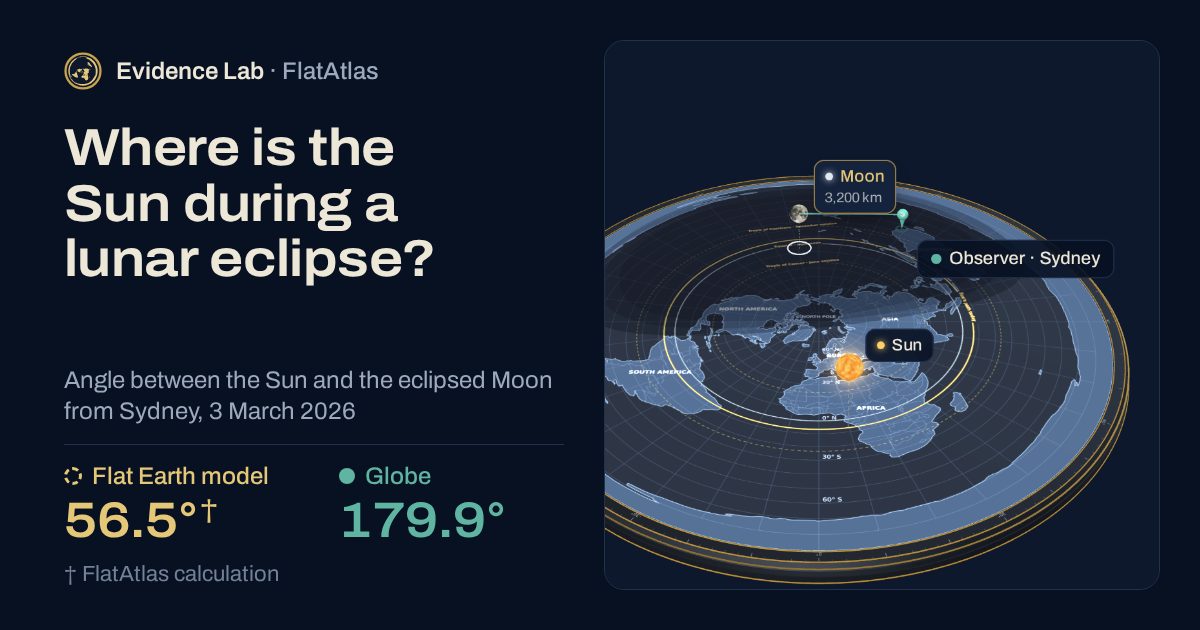
| From Sydney, at the greatest eclipse, the Sun and the Moon are on opposite sides of the sky | 56.5°† | 179.9° | Check it yourself |
| From Honolulu the Sun and the Moon are on opposite sides of the sky too | 101.5°† | 179.5° | Check it yourself |
| From Honolulu the eclipsed Moon is high in the sky at the greatest eclipse | 52.0°† | 70.3° | Check it yourself |
| From Bratislava, at midday local time, the Moon is below the horizon during the eclipse | 13.0°† | -35.4° | Check it yourself |
Worked out by FlatAtlas from the model as published, such as a flat surface, or the Sun and Moon heights FlatAtlas uses over Gleason’s map; the model itself gives no such figure. Each side’s own explanation is in the evidence map below.
Download the figures (CSV), free to reuse under CC BY 4.0 with a credit to the FlatAtlas Evidence Lab.
Evidence map
Cited by globe supporters
One of Aristotle's proofs for the rotundity of the world was the shape of the shadow on the Moon during a Lunar Eclipse.
Source: The Flat Earth Wiki: Lunar Eclipse due to Electromagnetic Acceleration
From Sydney, at the greatest eclipse, the Sun and the Moon are on opposite sides of the sky
Flat Earth model
56.5°
In the Flat Earth Society model both bodies are above the map: the Sun 4,800 km up, and the Moon 3,200 km up, which is FlatAtlas's reading of the wiki's “several thousand miles”. The figure is the angle between the two sight lines from Sydney over the FlatAtlas map. The wiki's Electromagnetic Acceleration page says the eclipse occurs when “The Moon is on opposite extremes of the Earth from the Sun”, with the Sun's light bending upwards; its Shadow Object page puts an unseen body between the Sun and the Moon. Neither page gives the angle seen from a place.
Source: The Flat Earth Wiki: Lunar Eclipse due to Electromagnetic Acceleration
Globe
179.9°
On the globe the Moon is in the Earth's shadow only when the Sun, the Earth and the Moon are in one line, so from anywhere the two are almost exactly opposite: from Sydney the Sun is 35° below the south-western horizon and the eclipsed Moon 35° up in the north-east.
Observed
No independent record yet
The gallery of the Wikipedia article on this eclipse has a photo of the totality from Sydney at 12:00 UTC. A photo that shows the time, the direction and the horizon tells where the Moon stood; compare it with where the Sun set that evening.
You can check it yourselfFrom Honolulu the Sun and the Moon are on opposite sides of the sky too
Flat Earth model
101.5°
On the FlatAtlas map Honolulu is about 2,500 km from the point under the Moon and about 18,300 km from the point under the Sun, and both sight lines rise above the horizon. The wiki's Electromagnetic Acceleration page says the eclipse occurs “when the Moon is on the opposite side of the ecliptic from the Sun”; it gives no angle as seen from a place.
Source: The Flat Earth Wiki: Lunar Eclipse due to Electromagnetic Acceleration
Globe
179.5°
On the globe Honolulu is on the night side at 01:34 local time: the eclipsed Moon is high in the south-west and the Sun about 71° below the horizon on the opposite side.
Observed
No independent record yet
Take a time-stamped photo of the totality from Honolulu (01:04–02:03 local time) that shows the direction of the Moon, and compare it with where the Sun rose later that morning.
You can check it yourselfFrom Honolulu the eclipsed Moon is high in the sky at the greatest eclipse
Flat Earth model
52.0°
On the FlatAtlas map Honolulu is about 2,500 km from the point under the Moon, so the sight line to a Moon 3,200 km up rises steeply. The wiki's Lunar Eclipse page says the totality “is seen by anyone who can see the Moon in their sky”.
Globe
70.3°
On the globe the point under the Moon is in the central Pacific, south-west of Hawaii, so from Honolulu the Moon is high in the south-western sky.
Observed
No independent record yet
Read the Moon's angle above the horizon from a time-stamped photo taken in Honolulu around 01:34 local time with the horizon in the frame, or from an observer's note made with an inclinometer, and compare it with both figures.
You can check it yourselfFrom Bratislava, at midday local time, the Moon is below the horizon during the eclipse
Flat Earth model
13.0°
On the FlatAtlas map Bratislava is about 13,900 km from the point under the Moon, and the sight line to a Moon 3,200 km up rises above the horizon. The wiki's Lunar Eclipse page says the totality “is seen by anyone who can see the Moon in their sky”, and its Shadow Object page adds that “the Moon is only seen during the day at a far opposite side of the sky from the sun”. The same page says that “a lunar eclipse can be seen from the entire half of the earth beneath the moon at that time”, without saying where that half lies on the Flat Earth map.
Globe
-35.4°
On the globe Bratislava faces the Sun at 12:34 local time, and the Moon, opposite the Sun, is over the night side of the Earth: 35° below the northern horizon.
Observed
No independent record yet
Look for time-stamped photos of the totality, 11:04–12:03 UTC, taken anywhere in Europe, and compare where they come from with the visibility map in the Wikipedia article.
You can check it yourself
Evidence and data quality
- Single report Flat Earth model The Flat Earth Wiki: The Lunar Eclipse: The totality “is seen by anyone who can see the Moon in their sky”; the page proposes two mechanisms, Electromagnetic Acceleration and a Shadow Object.
- Single report Flat Earth model The Flat Earth Wiki: Lunar Eclipse due to Shadow Object: An unseen body that orbits the Sun and passes between the Sun and the Moon; it is “never seen in the sky because it orbits the sun on the day side of the earth”.
- Single report Flat Earth model The Flat Earth Wiki: Moon: The Moon “is several thousand miles above the surface of the earth”; FlatAtlas reads this as 3,200 km, which is not a figure the wiki gives.
- Single report Both Wikipedia: March 2026 lunar eclipse: The contact times (totality 11:04–12:03 UTC), a visibility map and time-stamped photos from Asia, Australia, New Zealand and the Americas.
- Single report Both Wikipedia: Lunar eclipse, Selenelion: Just after sunrise or just before sunset an observer can see the Sun and the eclipsed Moon at once, both just above opposite horizons, because refraction lifts them.
- Calculation from a model Globe Astronomy Engine (Sun and Moon positions): Sun and Moon positions for any place and time on the globe, and the eclipse times; FlatAtlas uses it for every globe figure.
Data quality says how a figure was obtained, on the same scale for both sides. It does not rate which model is right.
Run the test
The same 3D model as the FlatAtlas app, with the Flat Earth Society heights. Set to 3 March 2026 at 11:33 UTC. Switch the observer between the places and follow the sight line to the Moon.
Free: the test from your place, right now. Pro: the test’s own date or any date from 1900 to 2100, with every planet and the full sky. One payment, no subscription.
Why is the lunar eclipse cited in the flat Earth debate?
On the globe a lunar eclipse happens when the Moon passes through the Earth's shadow, so the Sun, the Earth and the Moon are in one line and only the night half of the Earth can see it. Aristotle argued from the round edge of that shadow. The Flat Earth Society wiki takes up his argument on its Electromagnetic Acceleration page, and its Lunar Eclipse page proposes two mechanisms: the Moon moving beyond the reach of the Sun's upward-bending light, or an unseen Shadow Object passing between the Sun and the Moon. In both, the Sun and the Moon are above the map.
The flat Earth figures on this page are FlatAtlas's: the points under the Sun and the Moon drawn on its Gleason map, with the Flat Earth Society's 4,800 km for the Sun and 3,200 km for the Moon. The Moon's height is FlatAtlas's reading of the wiki's “several thousand miles”, not a figure the wiki publishes. At the greatest eclipse the point under the Moon (6.40° N, 170.62° W) and the point under the Sun (6.72° S, 9.55° E) are 20,035 km apart on that map.
What does the 3D test show?
The test is set to the greatest eclipse, 11:33:40 UTC on 3 March 2026 by Astronomy Engine (NASA's eclipse table gives 11:33:37). Switch the observer between Honolulu, Sydney, Tokyo and Bratislava and follow the sight line to the Moon across the map. Tokyo has no row in the evidence map: from there the globe puts the Moon 35.2° above the horizon and the FlatAtlas map 24.3°. The shading on the map is the globe's day and night drawn on FlatAtlas's Gleason map; the Flat Earth Society gives no size for the lit area, so the test does not draw one of its own. The scene does not draw the darkening of the Moon either: it shows where each model puts the Moon, not how it looks. See also the Sun's angle from two cities and the midnight sun in Antarctica, or read how Moon phases work on a flat Earth.
Frequently asked questions
Why is the shadow on the Moon round during a lunar eclipse?
On the globe it is the edge of the Earth's shadow, and Aristotle took its round shape as a sign of a round Earth. The Flat Earth Society wiki answers that a straight or slightly concave shadow also looks curved on the curved face of the Moon, and explains the eclipse by the Sun's upward-bending light or by an unseen Shadow Object.
Where could the March 2026 lunar eclipse be seen?
The totality lasted from 11:04 to 12:03 UTC on 3 March 2026. It was seen in full over north-east Asia, north-western North America and the central Pacific, rising over much of Asia and Australia and setting over the Americas. In Europe it was around midday: the globe puts the Moon below the horizon there, the FlatAtlas map above it.
Can I check it myself?
Compare time-stamped photos of this eclipse from Sydney, Honolulu or Tokyo with the Moon's height and direction on this page, and look for photos from Europe in the same hour. The 3D test shows the sight line to the Moon from all four places at the greatest eclipse.
Sources
- The Flat Earth Wiki: Lunar Eclipse due to Electromagnetic Acceleration
- Astronomy Engine (Sun and Moon positions)
- The Flat Earth Wiki: The Lunar Eclipse
- The Flat Earth Wiki: Lunar Eclipse due to Shadow Object
- The Flat Earth Wiki: Moon
- Wikipedia: March 2026 lunar eclipse
- Wikipedia: Lunar eclipse, Selenelion