The south celestial pole from Australia and South America: flat Earth vs globe
On the globe Sydney and Santiago share about 1 h 48 min of full darkness a day in June and none in December, and at 10:00 UTC on 21 June both see Sigma Octantis, next to the south celestial pole, above the southern horizon. The Flat Earth Society wiki answers a question about observers in Australia and South America seeing the same southern stars at once: it happens only a few months a year, because outside a small window one place is in daylight. The evidence map sets both side by side.
Astronomy and geodesy describe the Earth as a slightly flattened sphere about 12,742 km across, with the Sun about 150 million km away (NASA: Earth facts). FlatAtlas shows the published flat-Earth models next to that, so you can compare both with what you see.
| Case | Flat Earth model | Globe | Observed |
|---|---|---|---|
| In June Sydney and Santiago share full darkness for part of each day | No published figure | 1 h 48 min | Check it yourself |
| In December they share no full darkness | No published figure | 0 h | Check it yourself |
| From Sydney, Sigma Octantis, next to the south celestial pole, is above the southern horizon at 10:00 UTC on 21 June | No published figure | 33.5° | Check it yourself |
| From Santiago, at the same moment, Sigma Octantis is above the southern horizon too | No published figure | 34.5° | Check it yourself |
Download the figures (CSV), free to reuse under CC BY 4.0 with a credit to the FlatAtlas Evidence Lab.
Evidence map
Cited by flat Earth supporters
Q. How can two people on opposite sides of the earth in Australia and South Ameirca both see the same South Pole Stars simultaneously? A. The stars in the night sky are allegedly only visible simultaneously in these locations during a few months of the year. Outside of a small window, when it is day in one location it is usually night in the other.
In June Sydney and Santiago share full darkness for part of each day
Flat Earth model
No published figure
The Flat Earth Society answer says the two places see the night sky at the same time only during a few months of the year, and that outside a small window one of them is in daylight. The answer gives no figure for the shared hours.
Globe
1 h 48 min
On the globe both cities lie near 34° S, about 138° of longitude apart. In June the southern nights are long, and Sydney's late evening overlaps Santiago's early morning with the Sun more than 18° below the horizon at both.
Observed
No independent record yet
With a friend in the other city, note when full darkness begins and ends on the same June night and compare the shared time.
You can check it yourselfIn December they share no full darkness
Flat Earth model
No published figure
The Flat Earth Society answer says that outside a small window, when it is day in one location it is usually night in the other. It gives no figure for when the window opens and closes.
Globe
0 h
In December the southern nights are short: while it is fully dark in Sydney the Sun is up or only just set in Santiago, and the other way round.
Observed
No independent record yet
Repeat the June comparison in December and note whether both skies are ever fully dark at the same time.
You can check it yourselfFrom Sydney, Sigma Octantis, next to the south celestial pole, is above the southern horizon at 10:00 UTC on 21 June
Flat Earth model
No published figure
The wiki gives two flat Earth explanations of the southern sky: in the Monopole model perspective squeezes many stars into a small area of the sky, and in the Bi-Polar Model a South Pole has its own rotating sky above it. Neither gives a position for Sigma Octantis.
Globe
33.5°
On the globe the south celestial pole lies on the line of the Earth's axis, so from Sydney it is due south at about the height of Sydney's latitude; Sigma Octantis is at azimuth 179°.
Observed
No independent record yet
Photograph the southern sky from Sydney at 10:00 UTC on a June night (20:00 local time) and compare it with a photo from Santiago taken in the same minute.
You can check it yourselfFrom Santiago, at the same moment, Sigma Octantis is above the southern horizon too
Flat Earth model
No published figure
The Flat Earth Society answer questions whether observers in the two places actually see the same stars at the same time. Neither the Monopole model nor the Bi-Polar Model gives a position for Sigma Octantis.
Globe
34.5°
Santiago is at almost the same latitude as Sydney, so on the globe the pole is also due south at about the same height; Sigma Octantis is at azimuth 181°.
Observed
No independent record yet
Photograph the southern sky from Santiago at 10:00 UTC on the same June night (06:00 local time) and compare which stars appear around the pole in both photos.
You can check it yourself
Evidence and data quality
- Single report Flat Earth model The Flat Earth Wiki: Sun: The spotlight effect: the Sun lights only part of the map at a time; the page gives no size for the lit area.
- Single report Flat Earth model The Flat Earth Wiki: Bi-Polar Model: An alternative flat Earth map with a south pole and a southern celestial system turning above it.
- Single report Both Wikipedia: Sigma Octantis: The faint star closest to the south celestial pole, used to find south.
- Single report Both Wikipedia: Twilight: Astronomical twilight ends when the Sun is 18° below the horizon; FlatAtlas counts full darkness from there.
- Calculation from a model Globe Astronomy Engine (Sun and Moon positions): Sun and star positions for any place and time on the globe; FlatAtlas uses it for the sky dome and every globe figure.
Data quality says how a figure was obtained, on the same scale for both sides. It does not rate which model is right.
Run the test
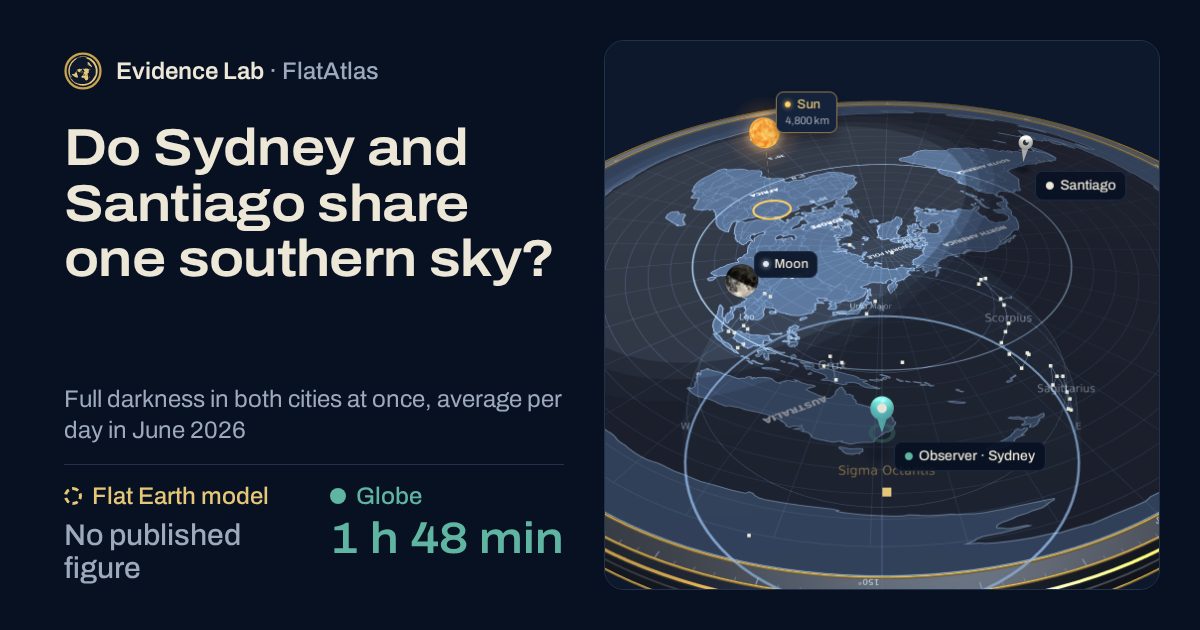
The same 3D model as the FlatAtlas app, with the Flat Earth Society heights for the Sun and Moon. The dome over the observer is the globe’s sky: star positions from astronomy (astronomy-engine), drawn over the FlatAtlas map. The Flat Earth model publishes no star positions, so the test does not draw any of its own. Set to 21 June 2026 at 10:00 UTC. Switch the observer between the places and find Sigma Octantis on the sky dome.
Free: the Sun and the Moon from your place, right now. Pro: this sky from your place, star by star, on the test’s date or any date from 1900 to 2100. One payment, no subscription.
Why is the south celestial pole cited in the flat Earth debate?
On the north-polar Flat Earth map Sydney and Santiago lie on opposite sides of the disc, far apart on its outer part; the nonstop flight between them is timed in the Sydney to Santiago flight time. On the globe both look south to the same point in the sky, the south celestial pole, around which the southern stars turn. The Flat Earth Society wiki takes up the question and answers that the two places share the night sky only a few months a year.
What does the 3D test show?
The test is set to 10:00 UTC on 21 June 2026, when both cities are fully dark. Switch the observer between Sydney and Santiago; the other city stays on the map as a second pin. The dome over the observer is the globe's sky from astronomy; the Flat Earth model publishes no star positions, so the dome is not the model's prediction. The line under the scene gives Sigma Octantis's height and direction. See also Polaris from the southern hemisphere and the Southern Cross from Europe and Australia.
Frequently asked questions
Do Australia and South America see the same southern stars?
Both see the stars around the south celestial pole, which never set from either place. They see them at the same time only when both are dark, which for Sydney and Santiago happens from about April to September, for up to about two hours a day.
How does the flat Earth model explain the southern sky?
The Flat Earth Society wiki describes two explanations: perspective in the Monopole model, and a South Pole with its own rotating sky in the Bi-Polar Model. Its answer to this question says the two places see the night sky at the same time only a few months a year.
Can I check it myself?
Arrange a call with someone on the other continent on a June night, photograph the southern sky in the same minute, and compare the stars around the pole. The 3D test shows both cities at 10:00 UTC on 21 June.
See this sky in My Sky in the app (Pro)