The Southern Cross from Europe and Australia: flat Earth vs globe
Acrux, the brightest star of the Southern Cross, never rises above the horizon in Bratislava or Cairo, while in Sydney it climbs about 61° high and never sets. The Flat Earth Society wiki explains the constellations an observer does not see by perspective and the vanishing point. The evidence map shows what each model gives for the three cities on 1 May 2026.
Astronomy and geodesy describe the Earth as a slightly flattened sphere about 12,742 km across, with the Sun about 150 million km away (NASA: Earth facts). FlatAtlas shows the published flat-Earth models next to that, so you can compare both with what you see.
| Case | Flat Earth model | Globe | Observed |
|---|---|---|---|
| In Bratislava Acrux never rises above the horizon | No published figure | -20.9° | Check it yourself |
| In Cairo Acrux stays just below the horizon | No published figure | -2.7° | Check it yourself |
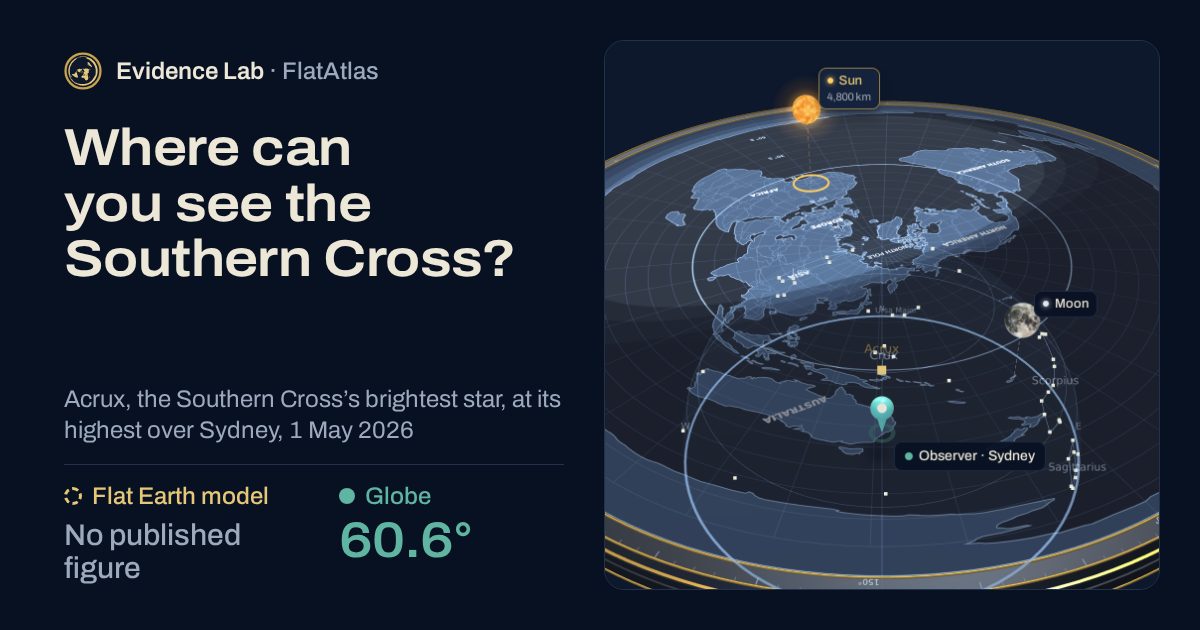
| In Sydney Acrux climbs high and never sets | No published figure | 60.6° | Check it yourself |
Download the figures (CSV), free to reuse under CC BY 4.0 with a credit to the FlatAtlas Evidence Lab.
Evidence map
Cited by flat Earth supporters
Ergo, when I stand outside and look into the skies, the star constellations I do not see are simply invisible past the vanishing point, beyond my perspective.
In Bratislava Acrux never rises above the horizon
Flat Earth model
No published figure
The Flat Earth Society wiki says the constellations an observer does not see are “invisible past the vanishing point”, and that travelling south brings a different set of stars into view. It gives no position or height for Acrux.
Globe
-20.9°
On the globe Acrux lies 63° south of the celestial equator, so it never rises north of about 27° N. Bratislava is at 48° N.
Observed
No independent record yet
Look south from Central Europe around 20:40 UTC on 1 May, when Acrux is at its highest, and compare with photos of the southern sky taken in Australia.
You can check it yourselfIn Cairo Acrux stays just below the horizon
Flat Earth model
No published figure
Applied to Cairo, the wiki's perspective account would mean Acrux is still past the vanishing point there. The wiki does not mention Cairo or Acrux, and gives no distance at which a star appears.
Globe
-2.7°
Cairo is at 30° N, a little north of the 27° limit, so at its highest Acrux stays about 3° below the horizon.
Observed
No independent record yet
From a place near 30° N with a clear southern horizon, look south around 19:44 UTC on 1 May; from farther south, Acrux appears low on the horizon.
You can check it yourselfIn Sydney Acrux climbs high and never sets
Flat Earth model
No published figure
Rowbotham, quoted on the same wiki page, describes “the rising of the stars in the south as we approach them”. Neither gives a height or position for Acrux.
Globe
60.6°
Sydney is at 34° S, south of the 27° S limit, so on the globe Acrux circles the south celestial pole without setting and stands about 61° high at its highest.
Observed
No independent record yet
Look south from Sydney around 11:46 UTC (21:46 local time) on 1 May, and again late at night: the Southern Cross is still above the horizon.
You can check it yourself
Evidence and data quality
- Single report Flat Earth model The Flat Earth Wiki: Stars: The stars move in a layer above the Sun, Moon and planets; the page gives no height or positions.
- Single report Both Wikipedia: Crux: Crux, the Southern Cross: from where it can be seen, and its use for finding south.
- Calculation from a model Globe Astronomy Engine (Sun and Moon positions): Star positions for any place and time on the globe; FlatAtlas uses it for the sky dome and every globe figure.
Data quality says how a figure was obtained, on the same scale for both sides. It does not rate which model is right.
Run the test
The same 3D model as the FlatAtlas app, with the Flat Earth Society heights for the Sun and Moon. The dome over the observer is the globe’s sky: star positions from astronomy (astronomy-engine), drawn over the FlatAtlas map. The Flat Earth model publishes no star positions, so the test does not draw any of its own. Each place is shown at its own moment: Bratislava, 1 May 2026 at 20:40 UTC; Cairo, 1 May 2026 at 19:44 UTC; Sydney, 1 May 2026 at 11:46 UTC. Switch the observer between the places and find Acrux on the sky dome.
Free: the Sun and the Moon from your place, right now. Pro: this sky from your place, star by star, on the test’s date or any date from 1900 to 2100. One payment, no subscription.
Why is the Southern Cross cited in the flat Earth debate?
On the north-polar Flat Earth map the southern hemisphere spreads around the outer part of the disc, and the stars turn above the North Pole at the centre. Observers in Europe never see the Southern Cross; observers in Australia see it every clear night. The Flat Earth Society wiki explains the difference by perspective: stars past the vanishing point are invisible. On the globe the Earth itself hides the southern sky from the north.
What does the 3D test show?
Each city is shown at the moment Acrux is highest on 1 May 2026, at night everywhere. The dome over the observer is the globe's sky from astronomy; the Flat Earth model publishes no star positions, so the dome is not the model's prediction. From Bratislava and Cairo the Southern Cross is missing from the dome; from Sydney it is high in the south. See also Polaris from the southern hemisphere and the south celestial pole.
Frequently asked questions
Can you see the Southern Cross from Europe?
No. Acrux, its brightest star, never rises north of about 27° N, so from Europe the Southern Cross stays below the horizon. From southern Egypt, India or Florida part of it shows low in the south.
How does the flat Earth model explain different stars in the south?
The Flat Earth Society wiki says the constellations an observer does not see are beyond the vanishing point of perspective, and that travelling south brings a different set of stars into view. It gives no positions for them.
Can I check it myself?
Compare night-sky photos taken at the same time of year in Europe and in Australia, or look south yourself on a trip across the equator. The 3D test shows each city at the moment Acrux is highest.
See this sky in My Sky in the app (Pro)